Sir Simon’s restless existence
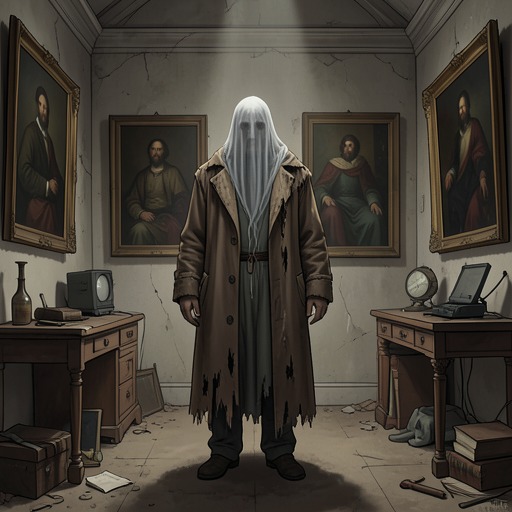
The Canterville GhostSir Simon’s restless existence is the ghost’s prolonged inability to sleep or find peace, a condition he describes as lasting three hundred years. Its decisive change comes when Virginia Otis hears his exhaustion not as another theatrical haunting but as a plea for rest. She agrees to help him, and after he dies she tells her family that he was truly sorry for his sins. His release turns the ghost story’s recurring spectacle of disturbance toward mercy, prayer, and an ending.
A Captivity Measured in Sleepless Years
When Sir Simon asks Virginia not to leave, he gives his haunting a new meaning: he is lonely and unhappy, and he wants to sleep but cannot. Virginia initially treats sleep as an ordinary bodily act, something as simple as going to bed and blowing out a candle. His answer breaks through that assumption. He has not slept for three hundred years and is profoundly tired. The span of time makes his condition more than a passing complaint; the ghost’s supernatural persistence has become a sentence from which he cannot escape by ordinary means.
The contrast between Virginia’s practical view of sleep and Sir Simon’s immense deprivation exposes the limits of the family’s earlier, everyday response to haunting. For him, rest is neither a joke nor a convenience. It is the relief he has been denied across centuries, and his appeal to Virginia shifts their encounter from fear and disturbance to compassion.
The Garden of Death
Sir Simon describes the place where he longs to sleep as a garden beyond the pine woods. In his vision, long grass, hemlock flowers, a nightingale singing through the night, the cold moon, and the sheltering arms of a yew tree frame the sleepers. Virginia recognizes it as the Garden of Death. The imagery recasts death as a quiet landscape rather than a spectacle of terror: the ghost longs to lie beneath the earth, beyond yesterday and tomorrow, forgetting time and life and finding peace.
That longing is not presented as a wish Virginia dismisses or misunderstands. Sir Simon asks for her help to open the portals of death’s house, linking the possibility of release to her love. His appeal makes the central tension of his state explicit: he remains present and conscious, yet cannot reach the rest he imagines. Death, in his account, would end not merely his life but the prolonged condition of being unable to sleep.
Virginia’s Compassion and the Prophecy
Sir Simon explains what Virginia must do: weep with him for his sins because he has no tears, and pray for his soul because he has no faith. He also tells her that fearful shapes and wicked voices may confront her, but that they will not harm her. Virginia answers firmly that she is not afraid and will ask the angel for mercy. Her decision is the turning point in the ghost’s restless existence: she accepts the emotional and spiritual work he cannot perform for himself.
The prophecy that a golden girl’s prayer will come from the lips of sin, that the barren almond will bear, and that a child will give away her tears gives this act a larger consequence. It promises that the house will become still and peace will come to Canterville. The ghost’s private exhaustion is thus joined to the fate of the haunted household: his release is not simply an end to his own suffering but the condition of a wider quiet.
After Virginia disappears with him, she returns and tells her father that Sir Simon is dead, was truly sorry for what he had done, and gave her a box of jewels before dying. The family follows her through a secret passage to a low room, where a chained skeleton lies beside a trencher containing only dust and a mould-covered water jug. The physical remains reveal the concealed extremity behind the ghost’s long unrest: he had been chained and left without sustenance. Virginia kneels beside the skeleton and prays, making her promised intercession part of the scene that discloses his fate.
Release and the Meaning of Rest
The supernatural confirmation of release arrives with the almond tree. A twin, watching from the window, sees that the old withered tree has blossomed in the moonlight. Virginia declares that God has forgiven Sir Simon. The barren tree’s sudden flowers answer the prophecy’s image and mark a change in the story’s atmosphere: the house’s haunting gives way to the possibility of peace.
Sir Simon’s restless existence therefore ends through a combination of confession, another person’s compassion, prayer, and forgiveness. His inability to sleep is answered not by a trick or by the family’s practical interventions, but by Virginia’s willingness to accompany him toward the death he imagines as rest. The revelation of his chained remains and the blossoming almond tree give that ending both a concrete trace of his suffering and a sign that the household’s long disturbance is over.